 English
 Pусский
 Español
 Apr 15,2026
To drastically reduce film waste, manufacturers must focus on three critical pillars: precision tension control, automated edge-guiding, and optimized sealing temperatures. Industry data suggests that poorly calibrated equipment can lead to a 5% to 8% scrap rate, which directly eats into your bottom line. By transitioning to servo-driven bag production systems and implementing real-time web tracking sensors, you can bring material loss down to under 1.5%. Addressing the root causes of misalignment and inconsistent heat-sealing parameters is the fastest way to recover your investment and improve sustainability.
The High Cost of "Trial and Error"
I’ve spent years on factory floors, and nothing is more painful than watching meters of high-quality PE or PP substrate pile up in the recycling bin during a botched setup. Many operators treat waste as an inevitable byproduct of the "warm-up" phase. It isn't. The primary culprit is often an outdated unwind station that fails to compensate for the varying inertia of a heavy film roll.
[Image: Close-up of a high-precision tension controller on a film conversion line]
When the film feed speed fluctuates even slightly, your print registration drifts, turning thousands of bags into expensive trash. Chovyplas addresses this by integrating hyper-sensitive feedback loops. If you’re struggling with high rejection rates during startup, you should explore the technical specifications of modern control interfaces to see how automation replaces guesswork.
Synchronizing the Mechanical Symphony
A common bottleneck in flexible packaging conversion is the lack of synchronization between the draw rollers and the sealing bar. If the mechanical timing is off by a fraction of a second, the film stretches. A stretched bag is a wasted bag.
- Micro-Step Feeding: Utilizing high-torque servo motors ensures that each movement is exact, preventing the "snapping" effect that leads to film deformation.
- Intelligent Thermal Control: Instead of constant heat, look for PID temperature regulation that adjusts to the machine’s speed, preventing burn-through during slower cycles.
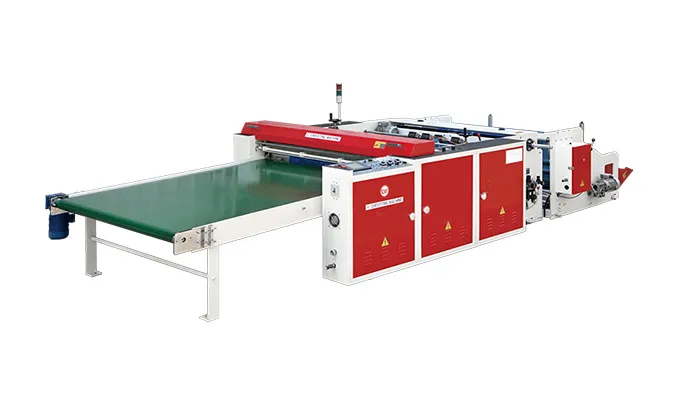
Most entry-level equipment relies on manual adjustments, which are prone to human error. Investing in automated bag making machines allows for recipe-based setups—where tension, temperature, and speed are pre-saved for every material type. To understand how these presets can streamline your workflow, you can learn about the modular design that accommodates both heavy-duty and ultra-thin films.
Why Advanced Engineering Outperforms the "Budget" Alternatives
In the competitive landscape of polybag manufacturing, there is a massive divide between standard machines and precision-engineered solutions. Cheaper models often use friction brakes for tension, which are notoriously inconsistent as the roll diameter shrinks.
This is where the Chovyplas philosophy stands out. Unlike basic hardware, our specialized bag making machines utilize magnetic powder brakes or active motor-driven unwinds. While a "budget" machine might save you capital upfront, the cumulative cost of wasted biodegradable film or multi-layer laminates over twelve months often exceeds the price gap of a premium unit. For those looking to calculate long-term ROI based on reduced scrap, it is wise to get the brand's tailored solutions for specific material thicknesses.
Scenario: Switching to Sustainable Substrates
These films are notoriously heat-sensitive and prone to stretching. On their old equipment, the waste rate hit 12%. By shifting to a system with pneumatic cooling bars and specialized anti-stick sealing knives, we stabilized their production.
This level of customization is what transforms a factory. Whether you are producing side-seal courier bags or bottom-seal heavy-duty liners, the equipment must be tuned to the "personality" of the film. To see how these custom configurations handle challenging materials, you might want to click for detailed configuration info and compare throughput benchmarks.
Achieving a Zero-Waste Mindset
Efficiency isn't just a technical metric; it’s a competitive edge. By minimizing the "dead zone" in your film path and ensuring every millisecond of the sealing cycle is optimized, you protect your margins and the environment. The future of manufacturing belongs to those who view every centimeter of film as a valuable asset.