 English
 Pусский
 Español
 May 14,2026
When a bag fails at the seal or tears under minimal load, the first suspect is rarely the machine. More often, it’s the material running through it. Selecting the right plastic type for your bag production line isn’t just about final product appearance — it directly impacts sealing consistency, printing adhesion, and overall throughput.
In this guide, we’ll break down the most common plastic resins used in bag making, compare their processing behaviors, and help you match each material to real-world production scenarios. Whether you’re producing T-shirt bags, zip-lock pouches, or industrial liners, understanding these differences will save you from costly downtime.
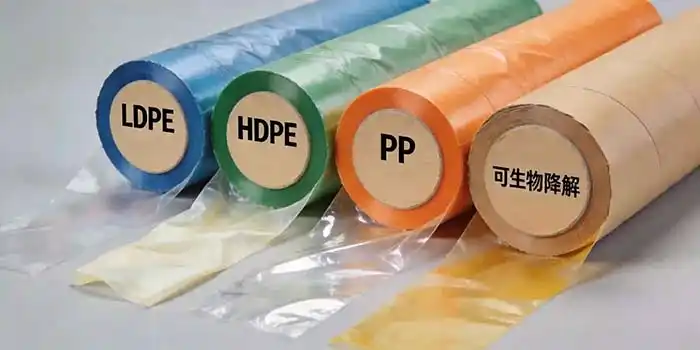
1. LDPE — The Flexible Workhorse
LDPE remains one of the most widely used materials for light-duty bags. Its long, branched polymer chains give it exceptional flexibility and high impact strength even at low thicknesses.
Key characteristics for bag making:
-
Melting point: 105–115°C — requires moderate sealing temperature
-
Low haze (excellent transparency for retail bags)
-
High elongation at break (>500%) — resists punctures
-
Shrinkage rate: ~2% — minimal dimensional change during cooling
Typical applications: Grocery bags, bread bags, dry-cleaning covers, produce roll bags.
Processing considerations: LDPE flows easily during extrusion but demands precise heat distribution on the sealing jaw. Uneven temperature often leads to “false seals” — the material sticks temporarily but separates under load. For high-speed lines, a machine with servo-driven seal bars and real-time temperature feedback is recommended.
*EEAT note: Based on production data from film converters, LDPE runs optimally at 80–120 m/min on standard bag-making lines when using chromium-plated sealing jaws.*
2. HDPE — Stiffness and Rustle
Unlike LDPE, HDPE has linear chains with minimal branching, resulting in higher crystallinity and stiffness. Bags made from HDPE feel crisp and produce the characteristic “rustle” sound — often preferred for merchandise bags and mailers.
Key characteristics:
-
Melting point: 125–135°C — higher than LDPE
-
Tensile strength: 20–30 MPa
-
Lower elongation (~300%) — more brittle
-
Better moisture barrier
Typical applications: T-shirt bags, garbage can liners, retail shopping bags, courier envelopes.
Processing challenges: HDPE’s higher melting point requires stronger heating elements. More importantly, its lower hot-tack strength means the seal must be held longer before cooling. Many operators mistake poor seals for machine problems when the real culprit is inadequate jaw pressure or cooling time. For HDPE, a bag-making line with adjustable dwell time and water-cooled sealing bars can increase productivity by preventing seal failure.
3. LLDPE — The Strength Blender
LLDPE combines the flexibility of LDPE with the tensile strength of HDPE. Its narrow molecular weight distribution makes it ideal for thin-gauge, high-strength films — often blended with LDPE to improve puncture resistance without losing softness.
Key characteristics:
-
High tensile strength
-
Excellent elongation
-
Lower seal initiation temperature
-
Better resistance to environmental stress cracking
Typical applications: Heavy-duty shipping bags, frozen food bags, stretch hoods, industrial liners.
Processing advantage: LLDPE seals at lower temperatures than LDPE, reducing energy costs. However, its higher melt viscosity can cause neck-in during extrusion. A bag-making machine equipped with anti-neck-in rollers and precise web tension control ensures consistent bag dimensions when running LLDPE-rich blends.
Industry data: ASTM D882 tests show that adding 20% LLDPE to LDPE increases seal strength by approximately 35% while maintaining similar clarity.
4. PP — Clarity and Heat Resistance
Cast PP and oriented PP are used for transparent bags that require high heat resistance, such as bakery or textile packaging. PP bags feel smooth, have glass-like clarity, and withstand temperatures up to 140°C.
Key characteristics:
-
Melting point: 160–170°C
-
Very high stiffness and tensile modulus
-
Excellent optical properties
-
Poor low-temperature impact resistance
Processing caution: PP requires a narrower temperature window than polyethylene. Too cold → incomplete seals; too hot → film distortion and sticking to sealing jaws. For consistent production, machines with PID temperature controllers and Teflon-coated jaws are standard. Additionally, PP’s higher stiffness demands precise folding mechanisms to prevent creasing.
5. Biodegradable & Compostable Resins — The New Frontier
PLA, PBAT, and starch-based blends are gaining traction for eco-conscious brands. However, their processing behavior differs dramatically from conventional polyolefins.
Critical differences:
-
Lower thermal stability (PLA degrades above 150°C)
-
Higher moisture sensitivity (requires dehumidified storage)
-
Different sealing profiles — some require impulse sealing rather than constant heat.
-
Faster film blocking (layers stick together) unless anti-block additives are used.
Practical advice: Running biodegradable resins on standard equipment designed for polyethylene often leads to frequent jams and poor seals. Look for bag-making systems that offer interchangeable seal jaws and adjustable sealing modes. Retrofitting an older line may cost more than upgrading to a machine built for multi-material flexibility.
How to Match Plastic Type to Your Production Priorities
No single material wins in every category. Use this decision matrix based on your top requirement:
| If your priority is… | Choose this material | Watch out for… |
|---|---|---|
| Lowest cost per bag | HDPE (thin-gauge possible) | Brittleness and lower seal strength |
| Clarity and printability | LDPE or CPP (PP for heat resistance) | Higher material cost (PP) |
| Puncture resistance for heavy loads | LLDPE or LDPE/LLDPE blend | Neck-in during extrusion |
| Eco-friendly claims | PLA or PBAT-based resins | Slower production speeds |
| High-speed sealing (over 150 bags/min) | LDPE with narrow MWD | Inconsistent cooling |
Common Material-Related Failures
Problem: The seal peels apart easily.
Root cause: Contaminated film (dust, oil) or incorrect sealing temperature.
Fix: Clean film surface using a corona treater; verify temperature with a contact pyrometer.
Problem: Bag length varies more than ±2 mm.
Root cause: Inconsistent film tension due to uneven unwinding — common with LLDPE’s higher neck-in.
Fix: Install a dancer roll tension control system or upgrade to a versatile bag-making system with automatic tension regulation.
Problem: Printed ink smears or scratches.
Root cause: Improper surface treatment (dyne level below 38 for polyethylene).
Fix: Inline corona treatment before printing — most modern bag-making lines include this module.
Beyond Material Selection: The Role of Machine Compatibility
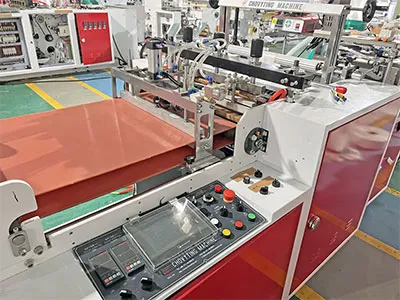
Even the perfect resin won’t perform on a line that lacks basic adjustments for that material type. Older machines with analog temperature controllers, fixed jaw pressure, and no tension feedback struggle with anything beyond a single material.
That’s where a multi-material bag-making solution makes a difference — not by reinventing the process, but by offering digital temperature zones, servo-driven sealing pressure, and material presets that operators can switch between LDPE, HDPE, LLDPE, or PP in under five minutes.
If you’re currently running multiple materials or planning to introduce biodegradable films, consider whether your existing equipment is the bottleneck. Many bag makers double their OEE simply by upgrading to a system that handles material variability without daily recalibration.
Final Recommendations
-
Start with your bag’s end-use — mechanical demands (load, puncture risk) always come first.
-
Test sealing parameters for each new resin batch using a bench sealer before full production.
-
Monitor film melt flow index (MFI) — significant batch-to-batch variation indicates poor resin consistency.
-
Document machine settings (temp, pressure, dwell time) for each material and keep a reference chart at the line.
For converters handling three or more plastic types weekly, a dedicated multi-format bag-making platform can reduce changeover waste by up to 60%. The upfront investment often pays back within six months through less scrap and higher machine utilization.
Disclaimer: Material properties and processing parameters vary by supplier. Always consult your resin vendor's technical data sheet and conduct trial runs on your specific equipment. The information above is based on industry standards (ASTM D882, D1922) and field experience from film converters between 2018 and 2025.
Note: The images in this article are for reference only.