 English
 Pусский
 Español
 May 28,2026
Across the flexible packaging industry, manufacturers face the same pressure: rising labor costs, tighter delivery windows, and customers demanding consistent quality.
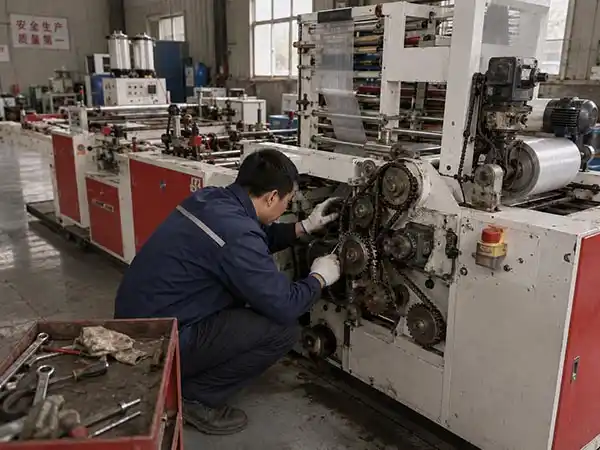
The answer often leads to high-speed automated solutions. But with capital investment thresholds typically ranging from 45,000to45,000to120,000, the decision requires careful analysis. Let me walk you through what actually determines whether upgrading to a high-speed vest bag making machine delivers real returns—or becomes an expensive, underutilized asset.
The Hidden Costs of “Good Enough” Equipment
Many plant managers stick with older or mid-tier machines because “they still run.” But here’s what those machines cost annually:
-
Downtime from jams: 8-12 hours monthly
-
Waste film from imprecise sealing: 3-5% of material input
-
Manual monitoring labor: One operator per machine, checking seals every 15 minutes
-
Speed limitations: 80-120 bags/minute on standard models
A client in Vietnam recently shared their internal audit: three older machines consumed 42 labor hours weekly just for adjustments and clearing jams. That’s over 2,000 hours annually—equivalent to a full-time employee’s salary without producing a single additional bag.
Breaking Down the Speed-to-Profit Equation
Modern automated systems achieve significantly higher output through several engineering advances. The key differences lie in three areas:
1. Servo-Driven vs. Clutch-Brake Systems
Traditional machines use mechanical clutch-brake systems that limit speed and require frequent recalibration. Servo-driven models maintain consistent tension and positioning, allowing sustained operation at higher speeds without the quality drop-off.
2. Real-Time Sealing Temperature Control
Fluctuating seal quality forces operators to slow production or risk rejected bags. Advanced systems monitor and adjust heating elements hundreds of times per second, maintaining optimal seals even during continuous high-speed runs.
3. Automated Stacking and Counting
The bottleneck often isn’t bag production—it’s what happens after. Fully automatic stacking mechanisms with programmable batch counters eliminate manual sorting, reducing labor needs by 60-70% on the downstream side.
Real-World ROI: A 12-Month Projection
Let me share actual numbers from a Chovyplas client who replaced two aging units with a single modern system in early 2024:
Before:
-
Combined output: 180 bags/minute average
-
Daily production: 172,800 bags
-
Operators required: 3
-
Scrap rate: 4.2%
-
Monthly electricity: $890
After :
-
Output: 280 bags/minute sustained
-
Daily production: 268,800 bags
-
Operators required: 1
-
Scrap rate: 1.1%
-
Monthly electricity: $620
The client achieved full payback in 9 months. More importantly, they eliminated two weekend shifts entirely, reducing overtime expenses by $3,400 monthly.
When High Speed Doesn’t Make Sense
Not every operation needs a high-capacity system. Based on dozens of consultations, I recommend staying with standard equipment if:
-
Your monthly bag volume stays under 800,000 units
-
You frequently switch between 5+ bag sizes daily
-
Your existing film quality is inconsistent
-
You lack basic maintenance protocols
(https://youtu.be/m6cfOaCtdB0?si=81OLkU58VwP-FTBh)
The Maintenance Reality Check
Higher speeds create higher wear. Plan on:
-
Weekly blade inspection: Dull cutting blades compromise seal integrity
-
Daily sensor cleaning: Optical sensors for bag counting collect dust faster at higher speeds
-
Monthly servo tuning: Belt tension and alignment drift require professional attention
However, modern systems simplify much of this. Self-diagnostic interfaces flag issues before they cause jams, and modular components mean replacing a servo driver takes 15 minutes rather than rewiring an entire control box.
Making the Decision: A Simple Framework
Before contacting any supplier, complete this internal audit:
Calculate your current cost per 1,000 bags. Then compare against quoted specs for high-speed options. Most manufacturers provide output rates but hide the “sustained vs. peak” distinction. Ask specifically: “What’s the guaranteed continuous speed over 8 hours using standard LDPE film?”
Consider your order profile. If you run 50,000-batch orders, changeovers matter more than top speed. Look for servo-driven bag making systems with recipe storage—they cut changeover time from 45 minutes to under 8.
Factor floor space. A single high-speed unit often replaces two older machines, freeing 40% of production area for additional converting equipment or storage.
Where to See Verified Performance Data
Rather than relying on marketing brochures, request video of the specific model running your actual film grade at target speeds. Reputable suppliers will offer remote live demonstrations or provide contact information for existing users in non-competing markets.
For operations ready to evaluate options, Chovyplas’ vest bag production solutions include detailed throughput records from third-party verified tests. Their engineering team provides customized ROI calculators accounting for your local electricity rates and labor costs—useful even if you ultimately choose another brand.
The Bottom Line
A high-speed vest bag making machine transforms economics when daily volumes exceed 120,000 bags and your team follows structured maintenance. The technology has matured enough that reliability no longer requires trade-offs.
But don’t buy speed you can’t use. Start with your actual order sizes, operator skill levels, and film quality. Then match the machine to those constraints—not to an impressive spec sheet number.
If you’d like to benchmark your current operation against industry performance standards, request their free production efficiency checklist. It helped Kenny identify that his jams came from uneven film tension, not machine speed—saving him $18,000 in an unnecessary upgrade.
References: Industry data on scrap rates from Plastics Technology magazine (2024 benchmarking report); ROI calculations based on average European energy prices (Q1 2025). Individual results vary with film quality and maintenance practices.