 English
 Pусский
 Español
 May 07,2026
Article Overview: This article explains how modern plastic bag making machines that incorporate blown film technology significantly reduce material waste, improve production efficiency, and help manufacturers meet sustainability goals. It covers the fundamentals of blown film extrusion, key machine features that minimize scrap, process optimization strategies, and the economic and environmental benefits for producers.
Understanding Blown Film Technology and Its Role in Waste Reduction
Blown film extrusion is a widely used process for producing plastic film, which is then converted into bags, packaging, and other products. In this process, molten plastic is extruded through a circular die, inflated into a thin-walled bubble, cooled, and collapsed into a continuous tube of film. This method inherently offers significant waste reduction advantages over other film-making processes.
One of the primary reasons blown film technology is effective at reducing waste is its continuous nature. The extruded tube can be directly fed into a bag making machine without intermediate steps such as slitting or rewinding, which often produce edge trim scrap. Because the bubble is formed in a seamless tube, the final bag dimensions can be precisely controlled by adjusting the bubble size and layflat width, eliminating the need for trimming. This near-net-shape production minimizes material loss from the outset.
Additionally, modern blown film lines incorporate advanced thickness control systems that maintain uniform film gauge across the bubble. Consistent film thickness means that bags meet strength requirements without using excess material. As the industry faces increasing pressure to reduce plastic use, blown film technology offers a practical path to source reduction—making bags lighter while retaining performance characteristics.
Key Machine Features That Minimize Material Loss
Plastic bag making machines themselves are engineered with several features that further reduce waste beyond what blown film technology alone provides. Understanding these features helps procurement and engineering teams evaluate equipment for their specific production needs.
Servo-Driven Tension Control
Servo motors and advanced tension control systems ensure the film unwinds and feeds consistently without stretching or wrinkling. Inconsistent tension often leads to misregistration, bag defects, and rejected products. By maintaining precise tension from the unwind stand through the sealing and cutting stations, modern servo-driven machines can reduce waste rates to less than 1% in well-tuned operations.
Automatic Waste Removal and Splicing
Many high-speed bag making machines include automatic waste removal systems that detect and eject defective bags without stopping production. For example, a machine might use a photo-eye to check for seal integrity or print registration and then divert faulty bags to a reject bin. Some systems also incorporate automatic film splicing, which allows a new roll to be joined to the tail of the expiring roll without line stoppage. This eliminates the waste typically associated with roll changes.
Precision Sealing and Cutting
Heated sealing bars and flying knife cutting systems are designed to produce clean seals and cuts with minimal film deformation. For instance, some fully automatic bottom sealing bag making machines use a flying knife system combined with hot slitting to create side gussets and seals in one pass. This integration reduces the number of process steps and associated scrap. Many manufacturers provide video demonstrations of these technologies; for example, you can explore plastic bag making machine videos that showcase servo-driven tension control and automatic sealing systems in action.
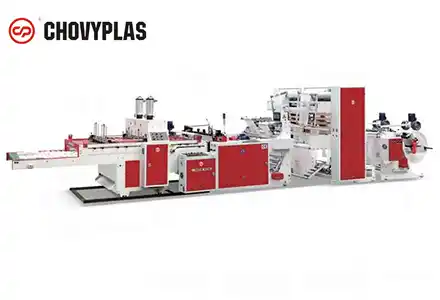
Process Optimization: From Extrusion to Bag Finishing
Waste reduction is not solely a matter of machine design; it also depends on process optimization across the entire production line. For blown film bag making, the integration of extrusion and bag conversion can significantly influence material efficiency.
Inline vs. Offline Processing
Inline systems that feed the extruded film directly into the bag making machine eliminate the need for intermediate winding, storage, and unwinding steps. This reduces handling damage, oxidation, and edge waste from multiple rewinding passes. However, inline systems require careful synchronization between extrusion speed and bag making speed, which is easier to achieve with modern PLC and servo control architectures.
Gauge Control and Layer Configuration
Blown film lines with multi-layer capability (e.g., three-layer coextrusion) allow manufacturers to use expensive barrier materials only where needed, while using lower-cost or recycled materials in the core layers. This reduces overall material consumption without compromising bag performance. Automatic gauge control (AGC) systems continuously monitor film thickness and adjust die gap, air ring cooling, and internal bubble cooling to maintain target gauge. Reducing gauge variation from ±10% to ±3% can yield material savings of 5–8%.
Waste Recycling and In-Line Refeeding
Advanced bag making machines can incorporate trim recycling systems that grind edge trim and other scrap, then meter the regrind back into the extruder. This closed-loop approach can recover up to 95% of production waste. However, careful material management is needed to avoid quality degradation from repeated recycling. Some suppliers, including those featured in rolling garbage bag making machine videos, show inline recycling systems designed for high-volume operations.
Economic and Environmental Benefits for Producers
Reducing waste through blown film technology and advanced bag making machines delivers tangible economic and environmental benefits that align with the goals of technical buyers and operations leaders.
Lower Material Costs
Plastic resin typically represents 60–70% of the total cost of a bag. Every percentage point reduction in waste directly improves the bottom line. For a production line running 1,000 kg of film per hour, a 2% waste reduction saves 20 kg of resin per hour. Over a year of operation, this can amount to tens of thousands of dollars in savings.
Improved Production Uptime
Automatic splicing, waste ejection, and less frequent adjustments mean higher machine availability. Many modern machines achieve efficiencies above 95% when properly maintained, compared to 80–85% for older equipment. This increased uptime translates to higher throughput and lower unit costs.
Compliance with Sustainability Regulations
Governments and retailers are imposing stricter requirements on plastic packaging, including recycled content mandates and waste reduction targets. By adopting efficient blown film technology and bag making machines, producers can reduce their environmental footprint and position themselves favorably in the market. Many manufacturers highlight their quality certifications to demonstrate compliance with international standards.
Choosing the Right Machine Configuration
When evaluating plastic bag making machines for waste reduction, consider the following technical criteria:
- Servo-driven sections for precise tension control
- Automatic film splicing and waste ejection capabilities
- Ability to run thinner films without sacrificing strength (gauge optimization)
- Inline or offline recycling options
- Dedicated profiles for specific bag types (e.g., T-shirt bags, garbage bags, heavy-duty bags)
Requesting a demonstration or viewing machine videos can help assess real-world performance. The product lineup from established manufacturers includes a range of machines designed for different waste reduction strategies.
Frequently Asked Questions
How much waste can a modern bag making machine reduce compared to older equipment?
Well-maintained modern machines can reduce material waste to less than 1–2% of throughput, whereas older machines often generate 5–10% waste or more. Combined with blown film technology, overall material savings can be significant.
Is blown film technology suitable for all types of plastic bags?
Yes, blown film is the most common method for producing films used in T-shirt bags, garbage bags, shopping bags, and heavy-duty sacks. It offers flexibility in film characteristics such as strength, clarity, and sealability.
What is the typical payback period for investing in a high-efficiency machine?
Payback depends on production volume, current waste levels, and local resin costs. For medium to high-volume operations, savings from reduced waste and improved uptime often result in payback within 1–2 years.
Can recycled materials be used in blown film bag making without increasing waste?
Yes, but careful formulation and process control are necessary. Lower melt strength of recycled resins can cause bubble instability and gauge variations. Multi-layer extruders can incorporate recycled material in inner layers while keeping virgin layers on the outside for processability.
Do more automated machines require specialized operators?
Modern machines often have user-friendly PLC interfaces, but training is still recommended. Many suppliers offer training programs to help operators optimize settings for minimal waste.
Conclusion
Blown film technology, combined with advanced plastic bag making machines, provides a robust approach to reducing material waste in bag production. From the continuous seamless tube of the blown film process to servo-driven tension control and automatic waste removal, each stage of the production chain can be optimized for efficiency. For CTOs, engineering managers, and operations leaders, investing in modern equipment not only lowers material costs and improves uptime but also helps meet evolving environmental regulations. By understanding the specific features and process integrations that drive waste reduction, buyers can make informed decisions that benefit both their bottom line and the planet.