 English
 Pусский
 Español
 Jun 23,2026
Article Overview: This guide helps buyers compare heavy duty bag making machines by analyzing key specifications, performance tradeoffs, and application fit. It provides a structured comparison table, decision checklist, and answers to common questions to support an informed purchase.
What Are the Key Specifications to Compare in a Heavy Duty Bag Making Machine?
When evaluating a heavy duty bag making machine, focus on parameters that directly affect output quality, speed, and operational costs. The table below compares two common machine configurations side by side.
| Specification | High-Speed Servo-Driven Machine | Mechanical Cam-Driven Machine |
|---|---|---|
| Bag Width Range | 200–1200 mm | 250–1000 mm |
| Production Speed | 80–120 bags/min | 40–70 bags/min |
| Automation Level | Fully automatic with servo indexing | Semi-automatic with manual adjustments |
| Initial Cost | Higher ($50k–$80k) | Lower ($30k–$50k) |
| Maintenance Frequency | Low (electronic components) | Moderate (mechanical wear parts) |
| Flexibility for Different Bag Sizes | High (quick changeovers) | Low (fixed settings) |
| Energy Consumption | Lower (servo motors) | Higher (constant motor run) |
Use this comparison to shortlist machines that match your production volume and budget. A heavy duty bag making machine with servo drive suits high-mix, high-speed operations, while a mechanical version is cost-effective for consistent, simple bag runs.
How Do Performance Tradeoffs Affect Your Heavy Duty Bag Making Machine Selection?
Every heavy duty bag making machine involves tradeoffs. Understanding these helps align machine capabilities with your operational priorities. Key tradeoffs include:
- Speed vs. Durability: Ultra-high speed machines may need more frequent maintenance; slower machines often last longer.
- Automation vs. Initial Cost: Fully automated lines reduce labor but increase capital expenditure.
- Flexibility vs. Specialization: Multi-functional machines handle various bag types but may compromise on speed for a single format.
- Energy Efficiency vs. Power Output: Modern servo systems use less power but may not match the raw torque of older direct-drive motors.
For example, a heavy duty bag making machine optimized for FFS (Form-Fill-Seal) applications emphasizes consistent film feeding and sealing integrity, whereas a bottom sealing machine prioritizes strong weld seams. The choice depends on your end product–whether you produce valve bags, woven sacks, or multi-layer laminated pouches.
Heavy Duty Bag Making Machine Use Cases and Application Fit
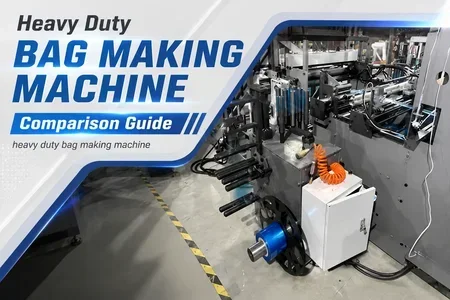
The ideal heavy duty bag making machine matches your production environment. Below are common use cases with recommended machine types:
- High-Volume Commodity Bags: Use a servo-driven heavy duty bag making machine with automatic winding and cutting. Example: fertilizer bags in 25–50 kg sizes.
- Valve Bags for Cement: Look for a heavy duty bag making machine with precise valve patch placement and ultrasonic sealing to prevent dust leakage.
- Heavy-Duty Laminated Pouches: Multi-function heavy duty bag making machines that handle single-sheet film and Doypack styles are required. Consider automatic bottom sealing with gusset options.
- Custom Short Runs: A mechanical heavy duty bag making machine with quick changeover tooling reduces downtime between jobs.
Refer to the FFS industry heavy duty bag making machine category for examples of high-speed continuous machines. For bottom sealing variants, the bottom sealing bag making machine page details models with adjustable seal bars and gusset assemblies.
How Do You Develop a Heavy Duty Bag Making Machine Decision Checklist?
Create a checklist that prioritizes your constraints. Use the following steps:
Step 1: Define bag specifications (width, length, gusset, seal type).
Step 2: Determine required production speed and shift patterns.
Step 3: Evaluate automation level: manual, semi-auto, or fully automatic.
Step 4: Compare supplier support, lead times, and after-sales service.
For a heavy duty bag making machine, also consider floor space, power supply, and operator skill level. Request test runs with your film samples before finalizing.
FAQ
What should buyers evaluate first about heavy duty bag making machine?
Start with fit, evidence-backed requirements, and supplier proof relevant to heavy duty bag making machine before shortlisting vendors.
How can teams reduce procurement risk for heavy duty bag making machine?
Use structured comparison, validate specifications early, and review implementation or quality checkpoints with documented evidence.
Conclusion
Selecting a heavy duty bag making machine requires careful comparison of specifications, tradeoffs, and application fit. Focus on your production volume, bag variety, and budget to shortlist suitable models. Use the comparison table and checklist provided in this guide to evaluate options objectively. Always request technical data sheets and machine trials to validate performance claims.